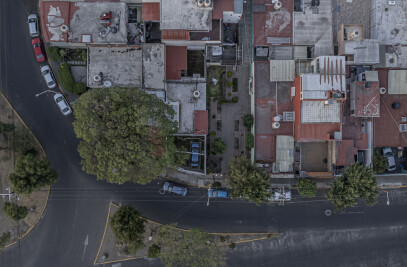
The site is located in a dense neighborhood of low-rise postwar houses, a short distance from the streetcar line that connects central Hiroshima to the Port of Hiroshima. The site, where the client was born and raised, originally consisted of a two-story wooden house that had been extended and reconstructed to fill the entire site, in close proximity to an adjacent house. For the reconstruction, the design direction was set to actively create an exterior space in the densely populated surrounding environment, and to realize a rich, expansive, and continuous living space to the exterior.


The north and east sides of the site have houses in close proximity, and the south side, which is currently a parking lot, is expected to eventually become a building. Therefore, to minimize the footprint, a three-story building was adopted to divide the site in two, and a blank space was left on the south side of the site. In this space, a parking lot which also serves as an approach to the entrance is located on the first floor, and a terrace facing the living room is located on the second floor as an exterior space, creating a void in the dense residential area that leads to the parking lot above the adjacent lot to the south.


The first floor consists of a spacious entrance space that doubles as a tatami room, a children's room, and a work space, the second floor consists of a living space that leads to the terrace, and the third floor consists of the couple's living space. The LDK on the second floor combines a living room flat connected to the terrace, a dining room and kitchen softly enveloped by steps, and a generous atrium, creating a simple planar composition with a horizontal extension to the outside and vertical connections to the upper and lower floors, creating a rich continuum of interior and exterior spaces.


The simple plan configuration is a simple yet effective way to create a rich continuity of space between the inside and the outside. Although the plan is very simple, the terrace, parking lot, and other external spaces connected to it ensure a certain degree of privacy from the front road and the surrounding environment, while at the same time providing living space that is more expansive and spacious than the area it occupies. The building, which stands dignifiedly in the surrounding gable-roofed streetscape and wall line, blends softly with the surrounding environment, while encompassing a rich lifestyle.


Team:
Architects: Yutaka Yoshida Architect & Associates
Structural Engineers: Kaneko Structural Engineers
Construction: Sun Construction Co.
Photographer: Katsumasa Tanaka


Materials Used:
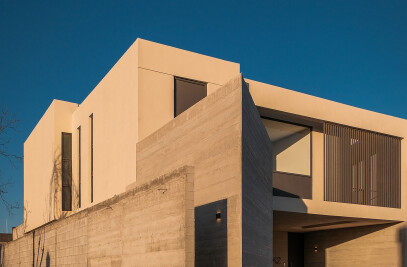
Facade cladding: Plastering wall, JOLYPATE, AICA
Flooring: Flexible board
Doors: Steel door,original
Windows: ThermosFG-L, LIXIL
Roofing: Galvalume steel plate
Interior furniture: Sofa, marenco,arflex
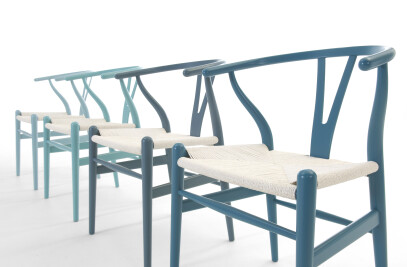
Chair,Ychair,carl Hansen & son
Table,original